Are you wondering what all the fuss is about AI and copywriting? Well, I certainly was until a few weeks ago when I finally had time to start investigating. What I found literally kept me awake at night, thinking about the potential of AI – not only for copywriting but also for many other uses.
AI has been lurking around in the background for many years, but the arrival of ChatGPT in 2022 brought it into the mainstream. So far, I’ve only been using free chatbots or large language models (LLMs) such as ChatGPT 3.5, Claude and Copilot, which form the basis of this post.
Here, I very briefly discuss my initial thoughts on AI and copywriting. Each of the points below could be a post (or two…) in itself, so please delve deeper elsewhere if you want to know more – in fact, I would strongly recommend it. Put simply, I’m just trying to help any novices out there to start to understand the use of AI for copywriting.
Disclaimer #1: I’m not an AI expert – I’m a copywriting and editing expert who is interested in AI.
Disclaimer #2: Opinions and thoughts on AI, like most things, vary hugely. For example, there is a widespread feeling that AI can’t replace humans, whereas some studies have shown that humans can prefer AI-generated content. As usual, the devil is in the detail. This post barely scratches the surface of AI, so it isn’t intended to provide the full story or any definitive answers.
So, here are my four key takeaways about AI and copywriting:
1. AI isn’t great at writing
Probably most importantly, I’ve found that AI isn’t actually very good at writing. Yes, the content it generates might be OK for some situations and it can be improved by careful prompting (see point #4 below). But often, the output can be bland, wordy, clichéd, filled with jargon and basically not what I would enjoy reading.
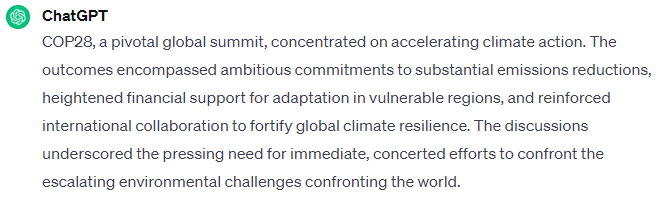
An example of ChatGPT’s attempt to describe the outcomes of the COP28 summit (note in particular the excessive use of long words)
Also, as you might expect, AI really struggles as the subject matter gets more complicated, such as scientific content (this study highlights factual errors – see point #2 below – and a “writing style” gap with AI).
So, I don’t think that AI can replace all copywriters, not yet anyway. Of course, AI’s writing will only get better as the technology develops. But even so, I’m still not sure that it will ever completely replace the unique and complex creativity of the human mind, which is so vital for interesting and engaging content. And then there’s a human’s grasp of true understanding, emotions, context, voice, humour, irony, cultural sensitivities and so on.
2. AI also hallucinates and isn’t great with references
AI delivers its results in a very authoritative manner, which initially seems very believable. But AI suffers from sometimes giving incorrect results, termed ‘hallucinations’. In fact, ChatGPT openly acknowledges at the bottom of its screen that it can make mistakes. So, it’s wise to double-check important things – outside of AI – before publishing any AI-generated content that is misleading or just plain wrong.
Of course, this problem isn’t unique to AI. Anything that you find on the internet could potentially be wrong, which is why you should always consider the source and its reliability. Also, it’s worth noting that the paid-for version of ChatGPT, for example, is said to be less prone to hallucinations.
Another consideration is that AI isn’t very good with references. For example, it will sometimes hallucinate (i.e. completely make up) a source, which will probably look genuine and authoritative to the unwary user. Sometimes, AI can even completely misinterpret a paper’s findings, so follow-up research is important.
3. … but it is good for certain things
There is plenty of good news though. Clearly, there’s an almost limitless number of applications of AI, but – just to stress – I’m focusing on copywriting here.
The biggest plus for me was using AI for brainstorming or creating an outline/structure. As a copywriter, starting with a blank page in front of you can sometimes be difficult. But through careful prompting (again, see point #4 below), AI can produce some workable ideas or an outline to get you started.
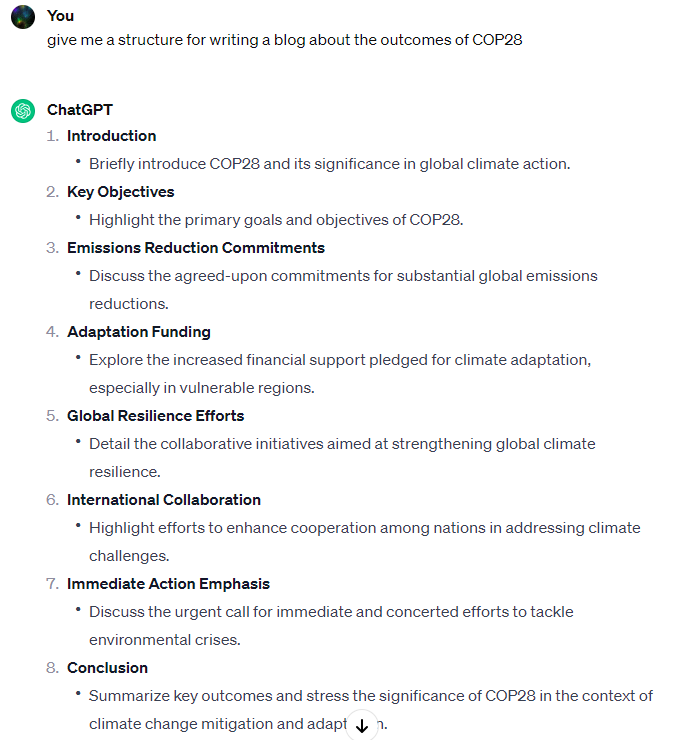
A simple example of ChatGPT’s suggested structure for a blog about the outcomes of COP28 – this structure clearly needs work, but for some people it might be better than starting with a blank page
Also, I found that AI did a reasonable job of summarising my text, which could be a useful aid for writing an introduction or final paragraph. On a related note, AI can create new social media content, or improve your posts to make them snappier and more exciting.
Similarly, AI is very useful for summarising a webpage, meaning that you don’t have to scroll through lots of text yourself to get an idea of the content.
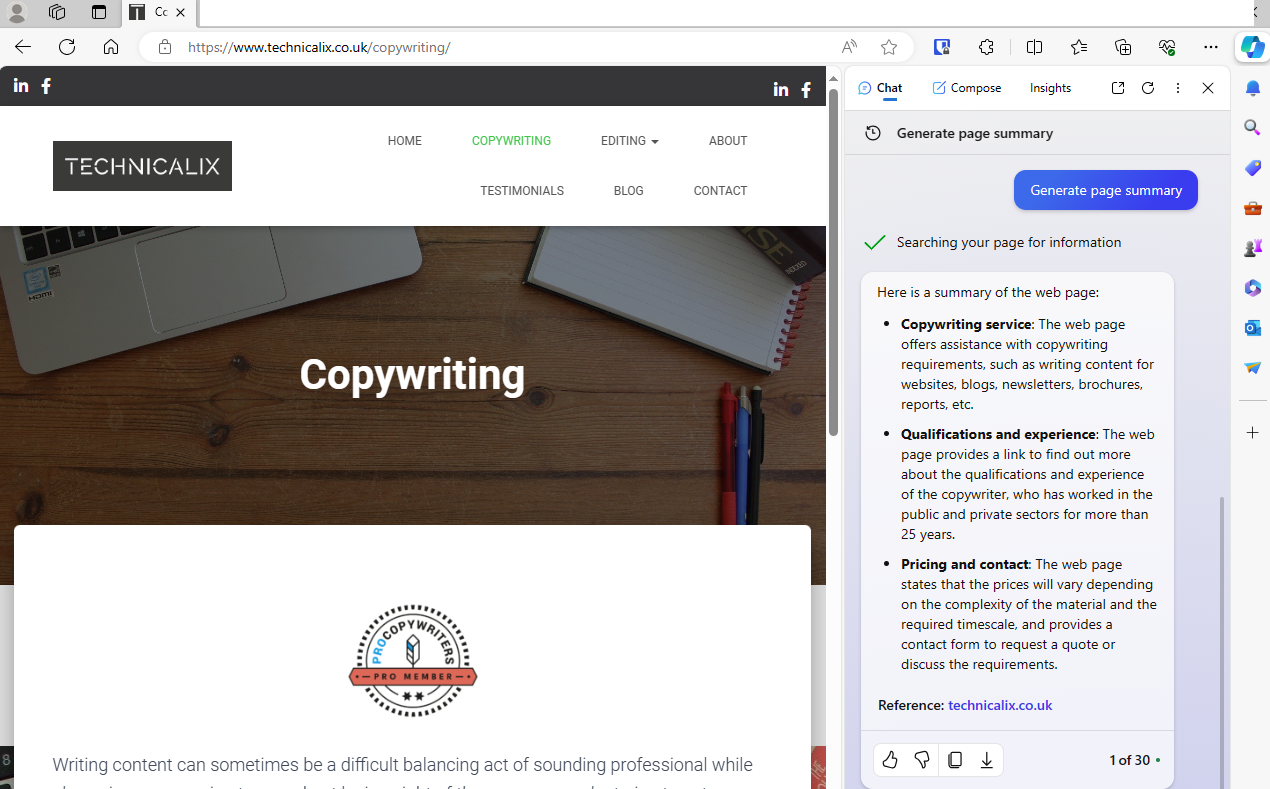
An example of using Copilot to summarise a webpage
4. It’s all about the prompt(s)
The prompt is the instruction that you give to the AI. It can be one sentence (e.g. “Please summarise the outcomes of the COP28 summit”) or many sentences (e.g. “Please summarise the outcomes of the COP28 summit. Use simple language. Use bullet points to display your answers. Use sentences no longer than 20 words.”). A quick play with AI will soon show you how vital the wording of your prompt is.
Just as importantly, the process of using AI is iterative, not simply a case of asking it a question and getting an answer. The beauty is that you can ask the AI to change or improve its answer as many times as you like. If the text is too complicated, you can ask the AI to use simpler language. If you want a real-world example adding to the third paragraph, the AI will certainly give it a go. If the example isn’t very good, you can ask for a different one.
Creating effective prompts already appears to be a huge area, with training courses in ‘prompt engineering’ flooding onto the market.
AI: your new junior assistant
To conclude, I like to think of AI as a junior assistant who works for me: the AI is eager to help but it’s not very good at its job, so I need to nudge it in the right direction several times and then improve its output myself. But it can undoubtedly make copywriting life easier – for example, by summarising text, brainstorming ideas and getting your creative juices flowing (to name just a few things).
 In some respects, this isn’t so different to pre-AI days. Depending on the circumstances, previously we might have bounced a few ideas off colleagues or started Googling a subject before writing about it. Nowadays, AI can help out with those things and more.
The easiest way to start to understand AI is to dive in and give it a go. This post barely scratches the surface of AI and so I would encourage all copywriters to find out more about AI themselves. Whether we like it or not, AI is going to make a huge difference to all our lives, both in the workplace and at home.
Thinking further afield
After playing around with AI for an hour or so, I soon went off-piste and expanded my investigations into things other than copywriting. Without any problems at all, I used it successfully to write some HTML code to tweak my website and also to debug a Word macro. Yes, I could have achieved the same results through other means, but it was much, much quicker using AI.
Then I read about some of the developments around using AI with images, which is when my imagination really started to run riot and kept me awake at night. I found myself watching TV and thinking: Hey, I wonder if AI could do that? This was for things like analysing the tactics of a sports team and then devising the best way to try to beat them (the answer is yes). Or for spotting swimmers in distress – or even sharks – in the sea at a busy beach (again, for swimmers and sharks, the answer is yes).
Actually, I’ve just had another thought: Maybe one day AI will come up with solutions for insomnia that really work.
